
English| EUR
Suggested for you
More currencies
Choose a language
The journey between Morocco's two most visited imperial cities spans the width of the country, crossing three mountain ranges and dropping from medieval medinas to Saharan plains. Understanding the distance and route options shapes every practical decision—departure time, vehicle choice, and whether to break the trip overnight.
Quick answer
The distance between Fes and Marrakech measures 530 kilometers via the N8 highway through Beni Mellal, the most direct paved route connecting the two cities. Drivers typically complete this journey in seven to eight hours under normal conditions. Two alternative routes add distance but offer different scenery: the 596-kilometer N13 route via Midelt and Errachidia passes through the Middle Atlas and desert edge, while the 541-kilometer coastal detour through Casablanca trades mountain passes for urban traffic.
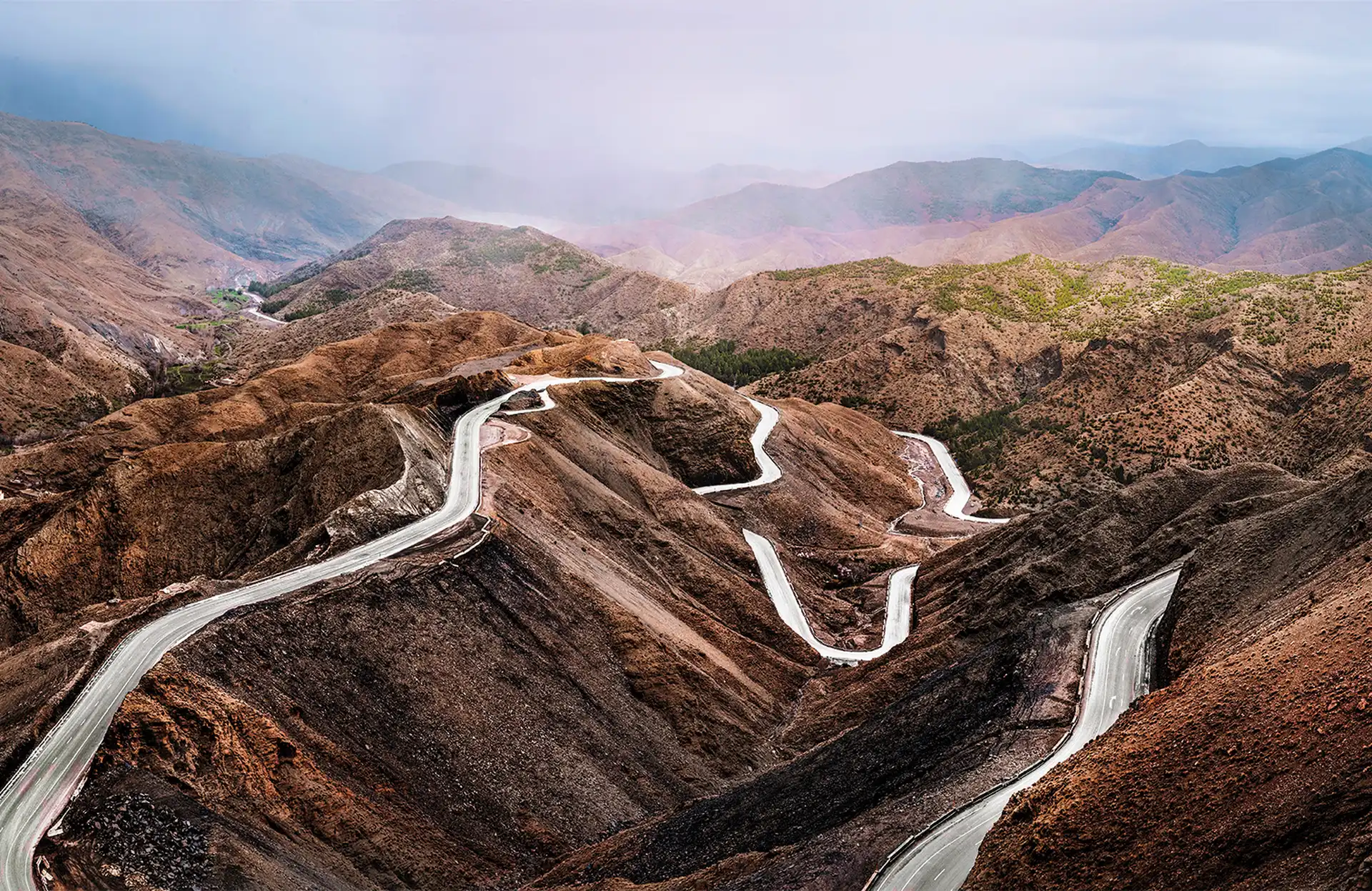
Morocco's N8 highway carries more intercity traffic than any other route in the kingdom, threading the gap between the Middle Atlas and High Atlas ranges while connecting four UNESCO World Heritage sites. The 530-kilometer artery handles everything from grand taxis to Sahara-bound tour coaches, its two lanes climbing from Fes at 400 meters elevation to the Azrou cedar forests at 1,600 meters before descending to Marrakech's plain at 450 meters. The Fes-Marrakech route divides into three geographic sections, each presenting different driving conditions. The northern third winds through the Middle Atlas via Ifrane and Azrou, where November through March snowfall occasionally closes the Zad Pass. The middle section straightens across the Tadla Plain through agricultural Beni Mellal, Morocco's fruit basket, where roadside stalls sell oranges and pomegranates from September through May. The final third navigates the foothills of the High Atlas, passing Oulad Yaich and the Red City's outlying palmeries before entering Marrakech through its northern Bab Doukkala gate. Road conditions shifted markedly after the 2016 highway expansion, which widened bottleneck sections near Khenifra and improved surfaces through the Atlas foothills. Drivers now maintain steady speeds outside towns, though livestock crossings remain common in rural stretches and police checkpoints operate near provincial boundaries. Fuel stations cluster in Ifrane, Khenifra, Beni Mellal, and the approaches to both terminus cities, with intervals rarely exceeding 80 kilometers. The alternative Midelt route via Errachidia adds 66 kilometers but rewards drivers with sparse traffic and desert vistas, particularly the Ziz Gorges south of Midelt. This eastern option serves travelers continuing to Merzouga or the Sahara gateway towns, converting a simple city-to-city transfer into a multi-day circuit. The Casablanca coastal route, meanwhile, suits those prioritizing flat terrain and frequent services over directness, though Casablanca's ring road congestion often negates any time saved by avoiding mountain grades.
“The N8 highway threads the gap between the Middle Atlas and High Atlas ranges while connecting four UNESCO World Heritage sites.”
The distance between Fes and Marrakech spans the diverse landscapes of Morocco, with the most direct route covering approximately 530 kilometers via the N13 and N9. Travelers may navigate this expanse through several transport methods, ranging from efficient rail links to scenic road journeys through the Sahara region.
N13 and N9 via Errachidia and Ouarzazate
ONCF Supratours connecting to rail
ONCF lines from Fes to Marrakech via Casablanca
Grand Taxi shared route
For those driving or taking private transfers, plan your departure to ensure arrival at your destination between 06:00 and 10:00 to avoid mid-day heat and traffic congestion.
This plan outlines a direct journey covering the 530 km route in a single day, suited for travelers prioritizing efficiency over sightseeing stops.
Leave early to maximize daylight driving hours and avoid mid-morning traffic through urban zones. Direct routes typically require 7-8 hours of continuous travel.
Navigate the winding mountain roads between Ifrane and Azrou, where elevation changes and curves add roughly 90 minutes compared to flat highway segments.
Brief pause in Beni Mellal or a roadside café for fuel and refreshments—budget 20-30 minutes to stay on schedule.
Descend from higher elevations into the Haouz plains, where traffic density increases as you near the city outskirts—final 60 km may take 75 minutes during peak hours.
Reach the city within the 06:00–10:00 arrival window when starting at dawn, though afternoon arrivals are common on direct routes without overnight stops.
The optimal time to travel between Fes and Marrakech is during the shoulder seasons of spring and autumn to avoid extreme temperatures. Regardless of the season, the recommended daily arrival window is 06:00–10:00 to mitigate heat and traffic congestion.
Mild with temperatures 18°C–25°C
This period offers comfortable transit conditions before summer heat peaks.
Pleasant with temperatures 17°C–24°C
Road conditions are favorable and daytime heat is manageable.
Very hot with temperatures 35°C+
High temperatures can impact travel comfort and engine performance.
—
Departing during this window avoids peak traffic congestion and mid-day heat.
Verdict: The best time to traverse the distance is between March and May or September and November, strictly adhering to the 06:00–10:00 arrival window.
Prepare these essentials before departing on the 530 km route between Fes and Marrakech.
Everything you need to know about distance between fes and marrakech
The road distance between fes and marrakech typically ranges from 530 to 580 kilometers depending on the specific route chosen. This journey connects two of Morocco's most historic imperial cities.
Driving directly via the motorway generally takes 6 to 8 hours, though opting for a multi-day desert tour will naturally extend the travel time significantly. It is best to plan your schedule based on whether you prioritize efficiency or sightseeing.
There is 0 MAD entrance fee for intercity travel between these locations. You are free to transit along the public road network as you please.
The best arrival window is 06:00–10:00 to avoid mid-day heat and traffic congestion on the roads. Starting your trip early helps ensure a smoother experience during your Morocco road trip.
Many travelers prefer taking a multi-day desert crossing through the Atlas Mountains and Sahara landscape instead of the direct motorway. This route allows you to see landmarks like Aït Benhaddou and Todra Gorge along the way.
Yes, you can take a train between the two cities, which takes approximately 6 to 7 hours with a change in Casablanca. The railway network is a reliable option if you prefer not to drive yourself.